Blog archives

News and blog

Day to day, week to week life at Blue Rooster.
Posted 2/1/2012 9:08am by Julie Hurst / Roy Brubaker.

This past summer and fall, Bob, with Roy's careful guidance, pulled several large oak trees out of our woodlot. An early summer storm several years ago caused a sudden wind burst that took out some of best "seed stock" trees just above our northeast pasture.   I've learned from forester Roy, that trees, like cows and sheep, should be selected for.  Leave the healthy, strong trees in your woods to replicate themselves for the future.  Put that way, it makes perfect sense to me.  Aren't we just trying to mimic natural selection?  But nature is a mysterious beast full of befuddling and random acts. With one strong gust roaring down the mountain, several dozen trees were downed, many of them marked as foundational to a healthy future woodlot. That said we decided to slice them up into a new barn floor. 

The outside bays of our barn have never been very strong and therefore a waste of good space. Getting thick, oak planking down has given us a lot more hay and machinery storage. As the new planks went in, the old, dry thin planks were pulled out and this winter we've heated the house with them.  It's been so mild that they actually lasted into February.  Admittedly this is not the cleanest form of heat, however, until our house is heated with solar panels or geothermal heat, it is probably one of our cleanest options.  At least we didn't have to haul it in.

Last weekend Roy and I spent several hours behind the garage cutting and stacking the planks to fit into our outdoor furnace.  The ewe flock is wintering in the pasture just behind the woodshed and at times I found myself mesmerized by the chewing motion of their mouths. During the afternoon the majority of the flock was laying on the ground, their jaws gentling grinding.  It is almost like watching waves wash up on shore. They seem so content when they are ruminating and the affect is calming. 

While most of the flock lay serenely chewing, the rest were gathered around the hay feeders eating hay and watching.  One ewe stood facing us, strands of hay hanging from her mouth, scratching her hind end on the corner of the feeder. I could of sworn she was daring me to comment, but I didn't.  Eating hay is an itchy business and if she needed to take care of her issues, I was fine with that. The flocks composed acceptance of the way things are had infiltrated the air around them and the more I watched them, the more I felt their calm stoicism settle into my being. 

Posted 1/18/2012 7:18am by Julie Hurst / Roy Brubaker.

Yesterday was cold, wet, and dreary.  I had errands to run in morning and indoor work to do in the afternoon. Once or twice I went outside to let the dogs out for a break or to put wood on the stove, but the dogs and I were equally interested in returning to our warm shelters. When the girls arrived home from school at 3:45, my "farm" work was necessarily and happily interrupted and my attention turned to their stories, their "desperate need of something to eat, NOW!" dinner plans, and the day's news on the radio. This sudden activity was a jolt to my quiet day (as I'm sure any parent who works from home can attest) and when the girls were settled into doing homework or playing, I slipped outside to check on the sheep. 

In the interim the day's rain had ended, the air was warm, and the light, so steely and gray earlier, was an incredible, luminescent gold. Perhaps you saw this sunset. I went about my business making sure the sheep's water tank was full, turning off the woodstove fan, kicking an old soccer ball for Mac and Pip, and in between, standing still to enjoy the glowing world around me. When I suspected the water tank was full I turned towards the sheep pasture; the sheep were standing still facing west too. There is a group of young ram lambs in our  far west paddock and my first thought was they were watching each other, but the ram lambs were facing west as well.  I've seen sheep stand still, all facing the same direction in the rain, usually with their faces away from the direction the rain is coming, but I've never witnessed this sort of... reverence? appreciation of beauty? fascination? from the flock.  The dogs didn't seem to notice the glorious sky; they were too busy chasing each other, dashing about looking for something to do. So there I stood with the sheep, facing west, bathed in radiant tranquility and wondering about this flock of wooly, sober, skittish sheep standing still beside me. They were lovely company as the sun sank low and shimmering sky gave way to darkness. 

Posted 1/6/2012 7:15am by Julie Hurst / Roy Brubaker.

Unemployment for a draft horse in his prime appears to affect him in ways similar to a capable young person who also cannot find suitable work.   In the past several months we struggled to know what exactly to do with our restless, moody fellow.   We do not want to and cannot afford to buy a horse that does not meet our needs just to give him companionship, nor can we afford to buy a horse that is guaranteed to be well-trained and match Bob's stature.  The right horse at the right price is out there, I'm sure, but when time and resources are at a premium, it requires some patience to find him or her.  

So... what about poor Bob?   He spent time with the steers on pasture, which he seemed to enjoy.   He found that galloping around them would create quite an entertaining circus; one solution to boredom is entertainment, after all. But these are the steers we are trying to fatten for market.  We don't want them to be fit and trim; they are supposed to get nice and pudgy as fast as they can.   Having a spunky horse rodeo-ing around them does not help put finish on a grassfed steer!

Roy recently had a day that allowed enough time to hitch Bob single to pull out some logs, however when he put on his collar it no longer fit.   Bob, at nearly seven years, is apparently still growing.   Luckily the next week Roy found a used collar for $50 at local Amish harness shop and shortly after hitched up Bob for a day in the woods.   

Most of our horse equipment is made for a team of horses but ground driving, walking behind the horse, is always an option.   Roy had several short logs that needed to be brought out of the woods and while one trip with the tractor or skid steer could have done it, it was definitely worth it to make several trips with Bob, for both Roy and the horse.   I'm not sure who was feeling worse about the situation, but getting the two of them back to work in the woods together was transformative.   Roy is now more patient with finding a suitable teammate for Bob knowing that working single is an option for the time being and Bob is so much more calm and social when we are in the barn.   It's as though he feels valued again; like he has a purpose on our farm.  

Yes, this is definitely an anthropomorphic interpretation of  Bob's demeanor.  Perhaps his muscles are just tired from working and he thinks that when he sees us he will get oats.   I can't say for certain.  But I know that working with some animals is incredibly satisfying because they seem to understand more than they can expressly communicate.   Horses and dogs especially communicate with their eyes, ears, and bodies what they want from their humans.  The mysteries of human / animal interaction gives me a lot of joy, but a mystery it will remain.   I am happy that Roy and Bob have found that they can work well together.  If Bob's contentment is only about oats, Roy's, I know for certain, is about collaborating with a massive animal on task that requires them working together and feeling the satisfaction of a job well done.

Posted 12/16/2011 7:51am by Julie Hurst / Roy Brubaker.

Last night the wind came roaring down the mountain at regular, sleep-disturbing intervals waking the girls and us up from our otherwise peaceful night. When I crawled out of bed just before dawn and peered out the window to the west, the tops of the spruce trees were churning and dancing in the moon and starlit sky. Minnie, our furry feline, sprung up to claw at the window on the backdoor while I was grinding coffee, and startled me out of my morning stupor.  Apparently the warm night she was shooed into before bed was no longer as inviting and she was ready for her daytime nap under the Christmas tree.

I usually try to schedule my week so that I am at home at least two full days. Those days might include a "quick" run to East Waterford, eight miles southeast, to go to the bank or perhaps a bike ride to check on the ewes a 1/2 mile down the road at our neighbors, but for large part of the day I am catching up with book work, communicating with customers, throwing in a load of laundry and preparing food. I admit, I love these days.  I love them more than I used to because they are a far rarer gem.  (I barely remember when I tried to find excuses to leave the farm, - a Christmas bazaar at a local church that usually offered very little I was actually interesed in purchasing -- an infant strapped onto my hip and another in a small stroller.)   Today is an "at-home" day and knowing I was going to be home,  Roy asked if I would feed the pigs and do the morning chores.  On a brisk, breezy, sunny morning, there are few things I like doing more.

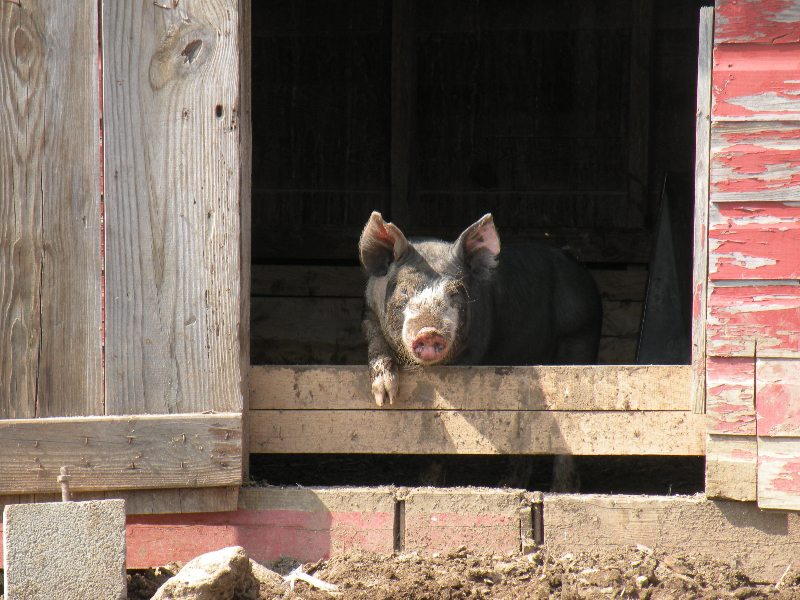
Ebony greets me when I enter the pigpen.   Ebony greets everyone but not everyone is as excited to see her as I am. She's a bit of a nuisance, but I can't helped but be charmed by her willingness to be scratched and petted, even if at times she might be actually trying to bite me.  I take it as affection; Roy and the girls think she's a bit aggressive.  When she gets to be three hundred pounds and comes running at me squealing and barking, I might change my tune. One has to find things to be amused by in life and Ebony makes that a simple task for me.

The dogs too bring us a lot of joy and amusement. They greet every day with so much energy and enthusiasm it is like unleashing pure happiness when we open their pens. They bound around chasing each other and dashing to each family member to get their morning greeting.  We've done a poor job at teaching them to stay "off".  It seems to take more discipline than they can manage to not try to greet us face to face.  What is so amusing about them is as soon as we give the "off" command they sit directly in front of us, noses pointed towards our faces, eyes pleading to be petted and rubbed.  Pip cannot just sit at look at us; she lifts her paw and persistently strokes our legs till we rub her ears.   It is so damn affective and impossible to resist.   I am constantly amazed at how clearly they manage to communicate, with eyes and head gestures, exactly what they want from us. They've trained us far better than we have them.

This morning Bob seemed a little lonely.  We know he is lonely for horse companionship, but he may need to wait a few more months. Finding the right horse at the right price is tricky.  He is now in the barnyard, close to the cows and pigs, but in his own pen.  Because he had been out on pasture for the last several months, it had been a while since I curried him.  He stood so still this morning while I curried the dust off his coat it was as if he were waiting for the pastor to serve him communion.  His hooves are large and his legs so powerful that to be close to them and feel they are completely relaxed is a holy experience.  So much grace is given to us from these creatures and so often our lives are too busy to recognize it.  Doing the chorse on a windy morning has done far more to bring light to my spirit in middle of winter than the brief time I spent shopping for stocking stuffers at Target yesterday. 


Posted 12/5/2011 8:17am by Julie Hurst / Roy Brubaker.

Deer hunting season in Shade Valley, like other rural areas of Pennsylvania, is a two week aberration from normalcy. Suddenly the quiet roads are busy and gun shots rumble and echo down the valley.   I used to dread hunting season. When we  first moved to this farm, new to the community, and without fences delineating our pastures from surrounding cropland, we had several confrontations with hunters taking wild shots from the road that divides it.  It felt like a dangerous time to live in the middle of deer country; and I grew up in a hunting family, married a hunter, and had started hunting myself. 

We have since gotten to know many of the local hunters, made it clear that our land is open for hunting as long as the laws and common hunting courtesies are obeyed, (such as asking for permission and not shooting from your beer-can strewn pick-up truck!)  We swap hunting stories with our neighbors who we otherwise rarely talk to and find that our connections to them and the community are strengthened.  I've found that other activities that place us in close proximity to the undomesticated world do not create the same sort of story-swapping culture; at least not among the folks we rub elbows with on a regular basis. A morning of cross-country skiing through the woods is fun, but no one seems interested in what I experienced out there, unless of course I was run down by a 12-point buck.  

This coming Saturday regular deer hunting season will close and for several weeks we will still have stories to swap with neightbors we meet in passing, but soon after the normal, quiet routines of winter resume and we'll hunker down in our individual homes and wait for the snowstorms to bring us out and give us new experiences to share.


Posted 11/30/2011 11:13am by Julie Hurst / Roy Brubaker.

I don't recall losing track of November in previous years.  It has always been the month of transitioning to the slower pace of winter, but this year it has nearly slipped by without an acknowledgement of how much changes on the farm during its short thirty days.  

Most years November is the month that we get all the animals settled into their winter homes and routines but this season has been mild and wet giving us several extra weeks of grazing for the sheep and cows.  Roy has the barn cleaned out and ready to move the beef cows down for the winter. The sows are in the former sheep pen where they are both sheltered from the cold and being put to work excavating the old floor so that in the spring we can dig out the original concrete and lower it to the level of the rest of the barn for easy cleaning.  Believe me this might sound like cheap labor, but... given the price of grain and that they aren't good at taking directions, I would not recommend them for anything too complicated.  They do raise cute babies though. 

The feeder pigs are in the chicken pen for the winter.  When or if the ground in the chicken run ever dries out, they will have access to entire run, but for now, we cannot afford to have them root up the ground around the fences and trees any more than they already have. Pigs on pasture are wonderful under the right conditions and disastrous in the wrong ones. Wet ground rooted and stomped on by pigs will dry into hard-packed, tight soil that is difficult to reseed or cultivate.  It's just like getting into your garden with a rototiller too soon after a spring rain.  I peeked in on the feeder pigs yesterday and they looked very warm and cozy snuggled together for warmth. "Pigs in a blanket" are happy pigs; makes me think that whoever coined that marketing term for wieners wrapped in dough knew a thing or two about pigs.

The sheep, like the cows, are still on pasture. Two weeks ago three breeding rams were put in with  the ewes.  We divided the registered ewes from the commercial ewes and gave them a ram all to themselves. In a couple weeks we'll pull the rams to ensure that spring lambing is limited to three or four weeks. We keep the sheep on pasture all winter providing them with hay and giving them a paddock with winter water access and some natural shelter from the wind.  Now that we lamb in the spring, the sheep need very little shelter.  In fact we've found they have fewer lung issues since we started keeping them out in the winter months.   We will bring them in to be sheared in March and if it is still cold they get a couple weeks to acclumate in the shelter of the barnyard.  But... that is all months away.  Time to be in the moment and enjoy the last bit of November. 

Posted 10/21/2011 7:51am by Julie Hurst / Roy Brubaker.

No doubt many of you are wondering what we are doing with our single draft horse, Bob, since we lost his teammate, Bud, last spring.    Like the old Bill Murray flick, we are back to taking baby steps towards incorporating draft horse power on the farm.  

Bob has had a leisurely summer.  We considered selling him and putting our draft horse dreams on the back burner again till we have the time and money for a new team.  There is no doubt that this would be the most logical move, but when it comes to Bob, it is hard to be emotionally detached.   He is such a sweet horse and we really like him.   Selling him would have been hard on so many levels.   We'd miss his big, gentle presence in the barn and pasture.   We'd certainly miss the work we have done and will do with him.   And, more selfishly, selling him would feel like admitting that horses just don't make sense in our day and with our lifestyle.  We've become quite busy.  Roy's new position is more enjoyable but more demanding than his previous one.   Our marketing efforts have increased keeping me quite busy and I've taken on some additional responsibilities at the FoodShed at Village Acres, Roy's parents' farm.  All these things have been good, but the question remains, is this lack of time to work Bob fair to him and does it make economic sense for us? Actually, we've accepted that Bob, without a teammate is hard to justify economically, but worth keeping all the same. So the real dilemma now is how to give him the life he deserves till we find a teammate we can afford to work with him.

A single draft horse has a lot to offer, but the jobs we can task him with are certainly limited.   He can pull logs out of the woods, he can pull a walking plow, and we can ride him.  Roy hopes to get him in the woods this fall to pull out firewood.   We only plow a tiny garden-size plot that would work him for a very short time and so far none of us have had the nerve to clamor on his back without a saddle, which for a draft horse is quite expensive.  And so we wait and Bob patiently waits with us.   He always seems to enjoy our company when we are in the barn and for now is out on pasture with the cows.    I think he seems bored sometimes; perhaps wondering when he'll be put to work or perhaps just lonely for another horse and we all feel bad about that.   Some days he runs around the cows and calves as though he just needs something to do.  

We have made some adjustments to our plans for using horses on the farm.  We've decided that with our acreage, number of animals, and lack of time, making hay with horses probably doesn't make sense, so Roy is in the process of selling some of that equuipment.  When we do get a second horse, we will likely use them primarily for logging, spreading manure, and clipping pastures with a sickle bar mower.  Hopefully by next spring we can introduce you to our new draft horse.  All in good time.  


Posted 10/13/2011 1:27pm by Julie Hurst / Roy Brubaker.

Late last spring we were excited to find a mama hen in the barn with seven newly hatched chicks.   Our chicken flock had been dwindling over the past several years and we were hoping for a naturally occurring population boost.  We collected them in a big green tub and brought them across the road to the house where we knew we could keep them safe till they were large enough to roost.   Perhaps our summer was busier than usual, but before long they were out of the tub and into a small dog kennel and then simply wandering around the yard where they were the fix for Mac's herding obsession during the boring months when his best playmate, Pip, was off at herding school.    Between Mac circling them constantly and their very attentive mother hen, (...and yes, Mac seemed to know that eating these chicks was not in his best interest as we were giving them a lot of attention) all the chicks survived their most vulnerable months, even the period of about two weeks when an immature Red-tailed hawk was eyeing them from the telephone wire.  

It was that hawk that took the blame for the sudden disappearance of the mama hen in early September.   The chicks had grown to the point that it was difficult to tell the difference between the mama and some of her chicks.  She had continued to faithfully cluck for them when she found food and at dusk she led them to the big garage where, when they were just tiny fluff balls, she had gathered them under her.  Then one day she just wasn't around.   The grown chicks wandered around in the yard, occassionally running to me or the girls, like aimless teens.   We were sad to have lost the mama hen as not all hens show the same proclivity for mothering.  We looked for her and we looked for her remains, assuming the young hawk may have finally gathered up the courage to take out the mama as she sounded the alarm for her chicks to take cover.    No luck.  No hen and no pile of bones and feathers.   She was simply gone. 

... Until one morning she came trotting across the road from the barn, a hapless rooster trailing along behind her.   She, the wise reader of Ecclesiastes, knew the time had come for her children to leave the nest and since they didn't seem to know where to go, she moved out, back to her previous home and one of the fathers of her brood.   She frequently comes to the house to visit them and usually brings the rooster along to keep Mac and Pip entertained while she chats it up with her chicks as they muddle through their Adjustment to Adulthood Disorder.    I'm afraid our neglect of the situation has added to the young chicks' angst.   We usually return chicks to the barn and chicken house when they begin to roost, but these chickens were late-roosters and we were either too busy or too lazy to make it a priority.   So for now we have yard chickens when what we want  are barn chickens.  One of these evenings we will gather the unsuspecting chickens as they roost and walk them across the road to the barn and chicken adulthood.   We'll see if it works.  Tranisiton to adulthood is never as easy as we would like it to be ... especially when a rural highway divides chick-hood from chickendom.


Posted 10/6/2011 5:03pm by Julie Hurst / Roy Brubaker.

I like wildlife.  I like domesticated life too.  And I enjoy the junction of wild and domesticated life as well.   Hanging out laundry is much more interesting when there is a hawk flying overhead or an indigo bunting is singing nearby.  Jumping several deer from the wetlands when we are going to move cattle is always a thrill.   Then of course there are the chipmunks.   They live so close to our house that they seem to be confused as to whether they are wild or domesticated.   In my mind it is quite clear and I wish I could communicate with them so as to clarify the situation.   Mini, our furball cat, is also certain.  She has presented me with at least two chipmunk carcasses in the last year,  carcasses that she brought up from the basement and deposited just inside her cat door in the dining room.  Our basement has an old drainage pipe that leads outside and apparently acts as a chipmunk thoroughfare.   Honestly, one very late night several years ago, I could of sworn I saw a little shrew scurry across the living room floor.  I think Roy believe it was a dream, but since then Mini has deposited some shrews just inside her cat door too.  

Early this morning Roy and I woke the sound of something fairly large, perhaps the size of a chipmunk, scuttling inside the wall behind our bed.   I was tired and just couldn't bring myself to care.  We've gotten used to this happening on occasion and as long as they stay in the wall, fine.  If they were rats...it would be a different deal but all evidence suggests they are chipmunks, so just let me get back to sleep.  But... this particular rodent had business to attend to.   Apparently it had found a very tempting nut to crack and was going to have at it in the warm, cozy, wall behind our bed.   The gnawing and grinding went on and on.  We got out of bed and pounded on the wall, hoping to send it scurrying for cover outdoors, but after a moment's silence, it started up again.   What should one do about critters in the wall?   From the sound of it, that little gremlin was only inches away from me,  only horsehair plaster and lathe was between us.  After several minutes, the absurdity of the situation got to us and we began to create a story to explain its behavior and amuse ourselves.  What else is there to do?   Finally, the chipmunk gave up and quietly sneaked away, no doubt leaving a tough, old, black walnut as a gift to future wall gremlins that invade our home.  

Posted 9/28/2011 12:41pm by Julie Hurst / Roy Brubaker.

Another three-plus inches of rain fell on our end of the valley yesterday morning.  The seasonal spring that runs from the mountain to the ridge just west of our house, spilled over it's banks creating a wide pond in the pasture.   Even during the several-days visit from Tropical Storm Lee the stream didn't venture so far from its path.   While soggy pastures and muddy barnyards weigh on one's spirit and boots, it is nothing to what vegetable and crop farmers face in seasons like this.   Not to mention those whose homes were damaged or destroyed by the recent flooding.   We've got mold growing in our laundry and downstairs bathroom from the humidity, but at least we have a laundry.  I flipped through photo's posted on a CSA member Kristin Camplese's food website, cuizoo, of the flooding in Bloomsburg and got a healthy dose of perspective.  If you have a moment, check out the photos -- they are poignant. 

Around lunch time yesterday I was up at Village Acres getting my orders ready for the evening State College CSA distribution when the local radio station playing in the packing shed announced that Juniata School district was dismissing early due to flash flooding.  Suddenly I was yanked out of work mode and into mother mode, scrambling to find a neighbor who could meet the girls as they got off the bus and take them home till I arrived.  As I was pacing and talking on my cell phone, my father-in-law, Roy-the-elder, came by humming a tune and offered to go pick up the girls while I went to my pre-scheduled doctor appointment.    Roy and Hope are very generous this way, always willing to help even in the midst of their own busy lives.  Thankfully my next-door neighbor was home and all to happy to help out too.

I've got a lot to learn from the elder Brubakers.  It has been a very difficult season for vegetable farmers because the extreme weather patterns of the spring, summer, and now fall too.  (This may be a pattern farmers in the Northeast need to get used too.)   Even with all the stress of crop failure, new projects, and management, Roy continues to sing and hum as he works and make himself availabe to help others in need.   Like the Energizer bunny,  the elder Brubakers just keep going and going.   Here I am in those years that are supposed to be the most productive and I feel tired when I think of how hard the two of them continue to work!  Not only work, but sing while working!